
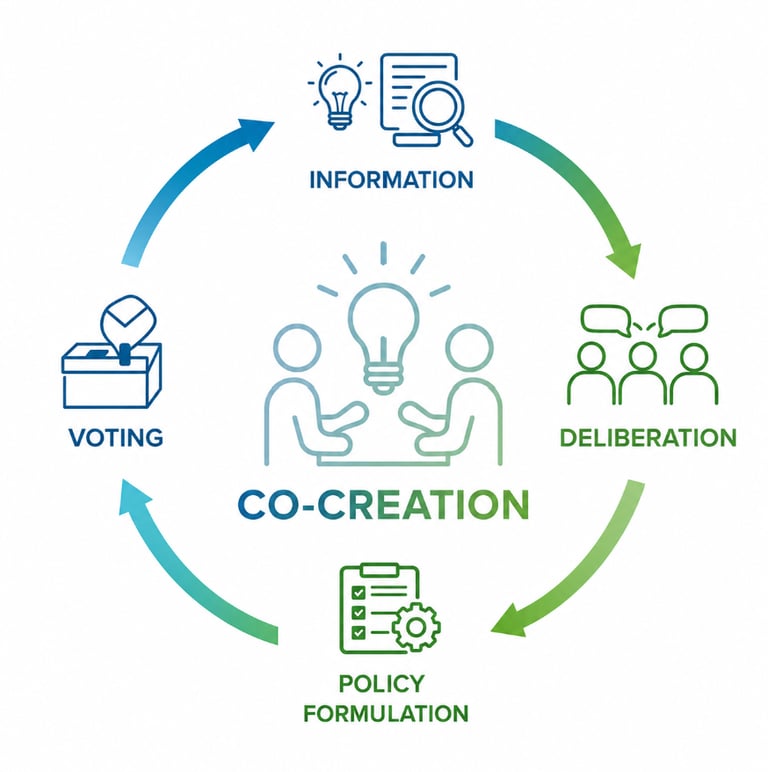
The democratic system can be seen as a connected cycle of four core functions: information, deliberation, policy formulation and voting. Many democratic innovations, in each of these functions, were developed to incorporate the voices of more citizens.
These innovations prove that participatory approaches in each of the 4 functions can yield remarkable results - and that combining them amplifies their impact. Yet, in practice, these functions often operate in silos and are channelled through political parties and institutional intermediaries. Learning from these innovations Wikipolicy integrates all four functions into a mutually reinforcing citizen-led direct e-democracy ecosystem.
Wikipolicy’s power lies in placing co-creation at the heart of its democratic model. It reimagines each function - information, deliberation, policy formulation, and voting - to serve collaboration, transparency, and consensus. Shared information builds the foundation for deliberation, which shapes policy formulation, while voting ensures that only broadly supported, well-developed proposals move forward.



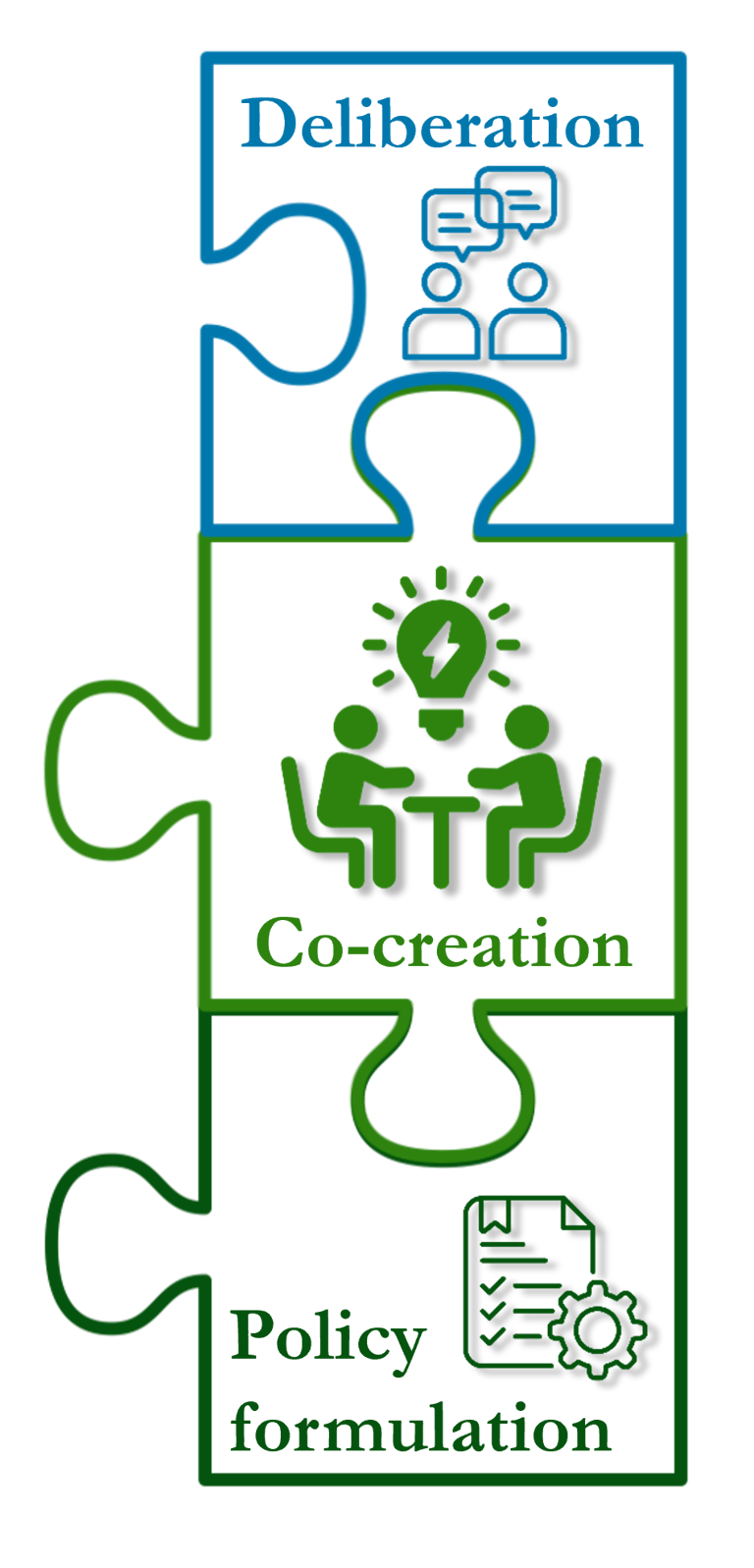
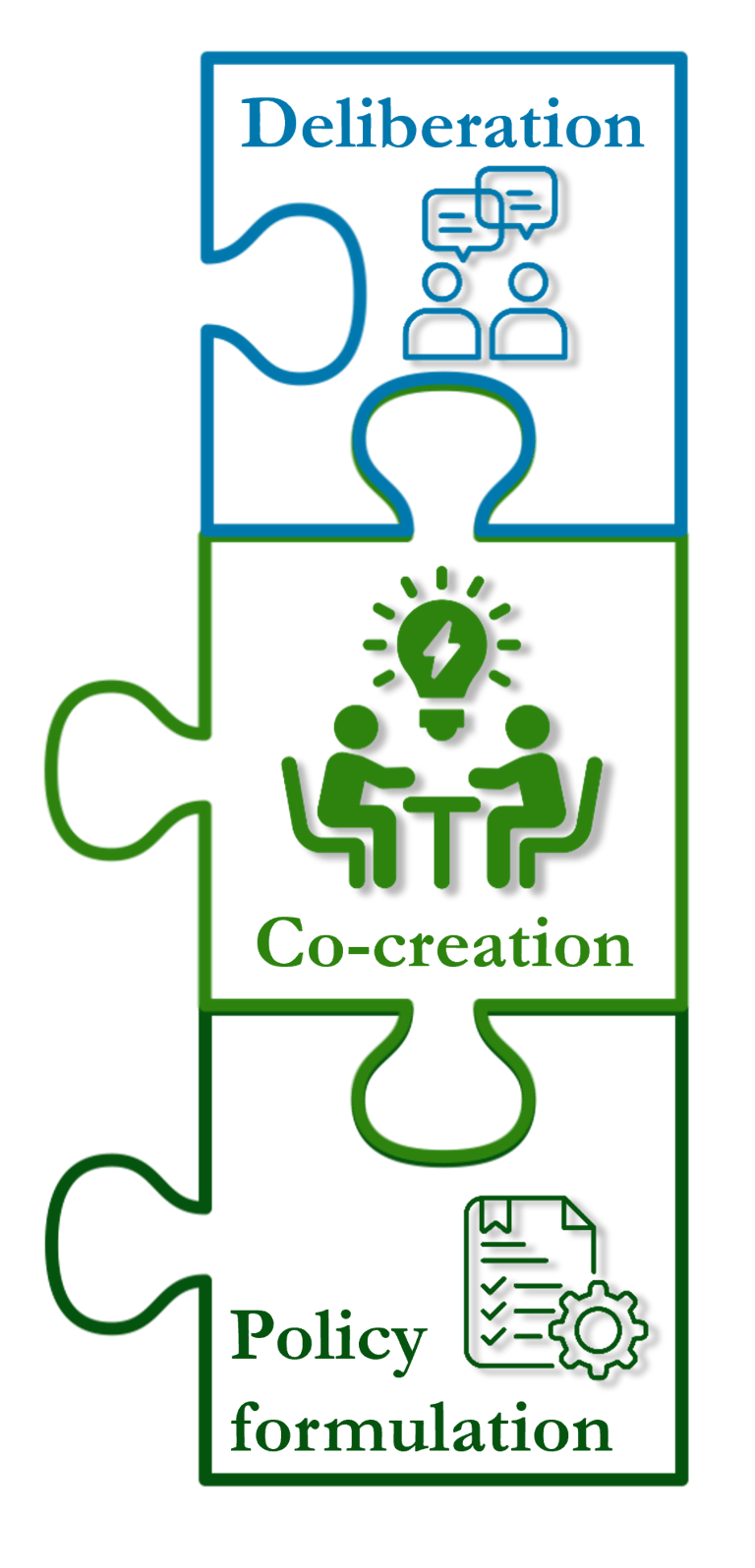
At Wikipolicy, consensus-seeking deliberation and policy-making are not separate steps - they are one seamless process: networked co-creation. Sharing information, debating, polling arguments, and collaboratively drafting proposals happens in real time, all interconnected through feedback loops. This ensures that every perspective directly shapes the policy as it evolves, rather than having discussions and decisions in silos.
By making policy-making iterative and consensus-driven, Wikipolicy ensures that proposals reflect collective intelligence, not just the interests of a few; leading to stronger, more legitimate policies that truly serve the community. Just like networked knowledge production (Wikipedia or open-source software), this process turns complex challenges into shared, high-quality solutions - proving that collaboration at scale works. Networked co-creation is the engine that makes democracy dynamic, inclusive, and responsive to the will of the community.
In the Wikipolicy model, voting serves as the gateway that ensures only broadly supported, well-developed proposals - refined through deliberation and co-creation – can move forward to formal consideration. It is the final validation of a collaborative, consensus-seeking process, rather than a stand-alone moment of decision. Unlike traditional majority-rule systems, Wikipolicy’s voting model prioritises qualitative consensus over quantitative volume, embedding safeguards like dual thresholds (minimum support and maximum opposition) and minority protections to prevent the tyranny of the majority. This approach ensures that voting is not just an act of aggregation but a natural extension of co-creation, where the collective will is both expressed and respected.

In Wikipolicy, information is not a static repository but the dynamic, validated foundation - a shared knowledge base (SKB) that enables co-creation. It ensures that all participants operate from a common information environment (CIE) preventing fragmented "epistemic worlds" where citizens and policymakers rely on different sets of facts. Without this, meaningful deliberation is impossible. By integrating information as an active, collaborative layer of the model, Wikipolicy transforms information from a passive input into the bedrock of transparency and trust, ensuring that every stage of policymaking is grounded in shared, verifiable evidence.
Building Blocks
The evidence is already here! From citizens’ assemblies to digital deliberation platforms, from referenda to petition platforms, participatory approaches have proven their power to build consensus, solve complex problems, and propose remarkable nuance and broadly carried policy proposals. Citizens are not only demanding to participate, they have proven to be more than capable in doing so!
Large scale co-creation platforms, such as Wikipedia and Linux, have proven that very large groups of people can produce a scale and quality of outputs that far surpasses traditional creation processes.
All the pieces of the puzzle exist - what’s missing is a system that brings them together, reinforcing each other to create a democracy that truly works for everyone. The tools, the demand, and the needs have aligned. Now is the time to act.
Wikipolicy is a model that brings all these pieces together in a connected cycle made up of four core functions: information, deliberation, policy formulation and voting. Wikipolicy integrates these functions into a cohesive, citizen led ecosystem, rethinking every function in support of consensus seeking co-creation.


IRISH CITIZEN ASSEMBLY
on abortion


ICELANDIC CONSTITUTIONAL COUNCIL




UK’s INCUBATOR FOR ARTIFICIAL INTELLIGENCE
SWISS REFERENDA




PEOPLE INITIATIVES
ESTONIA's















www.wikipolicy.net