
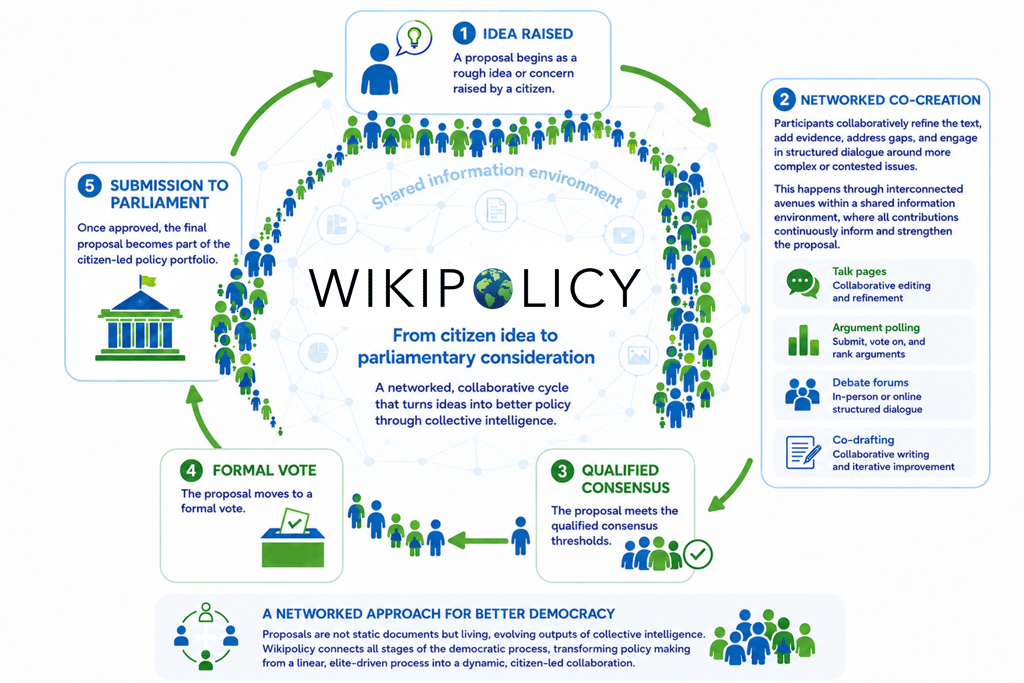




Idea Initiation marks the beginning of the Wikipolicy process, designed to be as open and accessible as possible. Any eligible voter can start a law proposal by meeting basic requirements (like clearly defining the topic or submitting a minimum number of resources to the shared knowledge base). The threshold for initiating a proposal is intentionally low: even a rough idea or concern can spark the process, as the platform’s collaborative nature allows others to refine, structure, and support it with evidence. This design ensures that citizen initiative is channelled into credible policy proposals through collective improvement, balancing openness with high standards for advancement
Idea initiation
Every policy proposal in Wikipolicy is linked to it’s own Common Information Environment (CIE). Once an idea is initiated, it will be connected to the Shared Knowledge Base (SKB) to build a shared, evidence-based foundation for deliberation. Citizens - some of which will be experts and policy makers - upload and curate evidence, data, and background documents. AI-tools assist by proposing summaries, classification of resources, and links to related proposals. The background summary must be supported by referenced sources, and all AI-generated contributions (such as tags, links, or summaries) are clearly labelled and subject to human validation. The result is a dynamic, common information environment for the policy proposal that evolves alongside it, grounding all subsequent deliberation in verified, shared evidence. All common information environments connect back to an expanding shared knowledge base that all participants can rely on. An AI assistant, restricted to this knowledge base and its supporting discussions, simplifies complex information, answers questions, and provides full transparency - tracking edits, rejected or new information, and lessons learned from past processes.
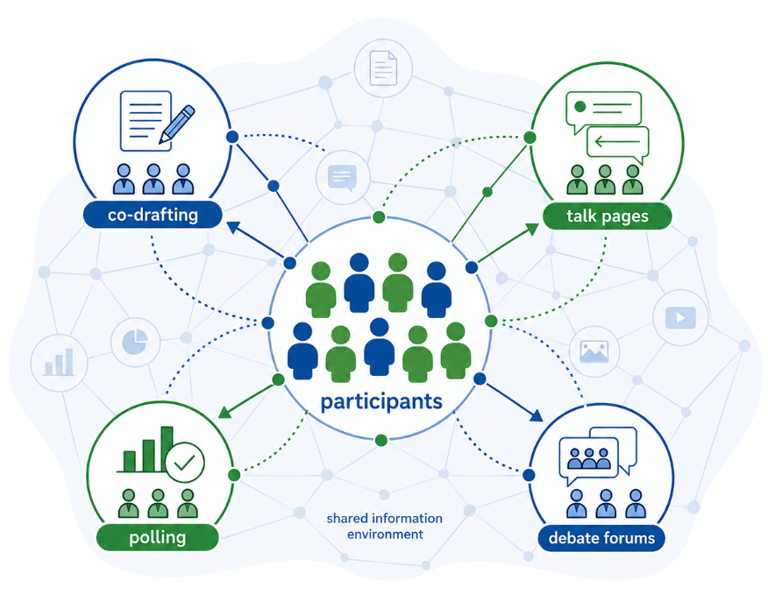
Deliberation and policy formulation are inseparable, unfolding through a combination of collaborative editing and structured dialogue; it takes place through four interlinked avenues:
Collaborative drafting (inspired by Wikipedia): Citizens can directly contribute to proposals, with changes tracked and visible to the community. Every edit, suggestion, or refinement becomes part of an open process of iterative improvement.
Talk Pages (inspired by Wikipedia): Dedicated spaces to debate specific edits or ideas, ensuring disagreements are addressed constructively and insights are integrated back into the proposal.
Argument polling (inspired by Pol.is): Participants can submit, vote on, and rank supporting and opposing arguments, helping surface areas of consensus, highlight unresolved concerns, and guide the evolution of the proposal.
Debate forums: For complex or contested issues, moderated online or in-person discussions create space for deeper deliberation.
All contributions - whether edits, arguments, or debate insights - are constantly fed back into the proposal and to each other, creating a dynamic, interconnected network of co-creation (see visual). This ensures that the final policy reflects the collective intelligence of the community, not just the sum of its parts.
These tools enable participants to engage in consensus-seeking deliberation. Rather than simply expressing preferences, participants examine evidence, identify common ground, and work through disagreements, reducing polarisation by highlighting areas of agreement and resolvable conflicts; constructive critique replaces adversarial debate. Through this continuous exchange - where diverse perspectives are heard, weighed, and integrated - proposals evolve into informed, balanced, and democratically legitimate policies. The result is a process that ensures every voice is considered, fostering collaborative problem-solving over ideological conflict and reflecting the collective wisdom of the community.


Networked co-creation
Creation of a shared information environment
Where deliberation meets policy-making
Throughout the co-creation process, proposal polling acts as a dynamic consensus steering mechanism, continuously guiding the proposal toward broad agreement. Participants signal their support, opposition, or conditional approval ("Yes, but") in real time, creating a living feedback loop that highlights unresolved concerns and areas of alignment. Additionally, minority protections (e.g., disagregated polling for affected groups) ensure that no community is sidelined in the process.
Once the proposal stabilizes and meets dual thresholds - a minimum support threshold (e.g., 20,000 votes) to ensure sufficient backing, and a maximum opposition threshold (e.g., <20%) to guarantee that dissenting voices are respected - it is considered to have reached sufficient consensus. At this point, the proposal is frozen to prevent further edits, marking its transition from a living draft to a stabilized consensus text ready for formal validation. This ensures that only well-developed, widely accepted proposals advance.
Qualified consensus

Formal voting
The formal vote is the final step in validating the collective will. All eligible voters can participate, casting their vote to confirm or reject the proposal. Unlike traditional majority-rule systems, Wikipolicy’s voting model prioritizes qualitative consensus, ensuring the proposal reflects broad, informed agreement rather than a simple headcount. This process ensures that only proposals with democratic legitimacy and community backing move forward, bridging direct citizen participation with institutional decision-making.


Once approved, the proposal becomes part of the citizen-led policy portfolio. Approved proposal are submitted to parliament (or the relevant legislative body) for consideration, completing the journey from citizen idea to parliamentary action. To ensure seamless integration with existing democratic structures, initially, Wikipolicy will leverage existing petition systems (e.g., Belgium’s 25,000-signature threshold or the EU Citizens’ Initiative). This approach channels proposals backed by collective intelligence and democratic legitimacy into formal policymaking, providing legislators with a comprehensive, transparent, and community-validated proposals for review.
However, the impact of citizen-led policies extends far beyond parliamentary submission. Whether or not parliament takes action, individual policies or the portfolio as a whole can be adopted by advocacy groups, citizen movements, other parts of government, or even political parties. In this way, the portfolio becomes a living, evolving body of work - a persistent force for change that grows in influence, regardless of institutional uptake.
Submission to parliament


www.wikipolicy.net