


Since the 19th century, responsibility in both economic and political spheres has steadily shifted from individuals to legal entities. In the last 20 years this shift has been clearly visible in the political domain. Not only the number of organisations working as pressure groups has dramatically increased, but also the diversity of those organisations (e.g. businesses, professional associations, NGOs, civil rights organisations, environmental organisations, consumer associations, think tanks,…). While these entities often represent large groups, their reasoning is shaped by institutional and corporate logic, not the nuanced moral frameworks of individuals. They operate within fixed mandates, and their actions, though sometimes subject to public oversight, lack the moral complexity of human judgment.
Now, the rise of artificial intelligence is pushing democratic responsibility even further away from citizens. AI systems, controlled by a handful of powerful actors, structure how information flows, how opinions form, and even how policy debates unfold. Unlike legal entities, AI operates at unprecedented speed and scale, with even less transparency and accountability. Governance frameworks lag behind, and experts warn, this gap risks eroding the very foundation of democratic responsibility.
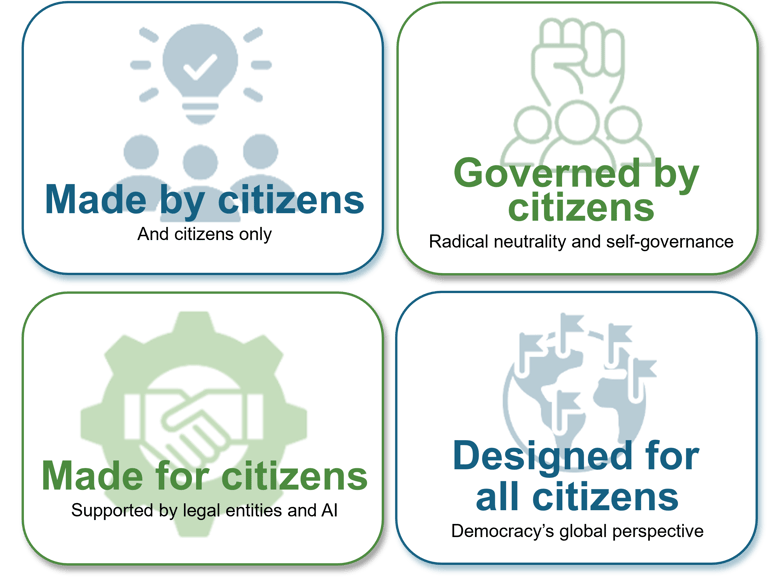
Wikipolicy redefines democracy as a citizen-centred, adaptive, and globally inclusive system built on four interconnected principles summarised as Made by Citizens for Citizens, and Governed by Citizens for all Citizens. Together, these principles ensure that democratic power, responsibility, and legitimacy remain firmly in the hands of citizens, while leveraging the strengths of legal entities and AI as enabling tools - never as replacements for human agency.
Wikipolicy’s core principle is simple: democracy must be shaped by people, not institutions or algorithms. This principle is about reclaiming something that has quietly been given away: “the idea that in a democracy, real people are ultimately responsible for the decisions that shape their lives”. They can be recognised, questioned, and held to account by their peers. By linking participation to individual responsibility, Wikipolicy creates the conditions for consensus that is not only open and inclusive, but genuinely accountable.
Therefore, only eligible voters - real, verifiable human individuals - can contribute, edit, and vote on the platform. The model restores individual human responsibility to politics, ensuring that legal entities and AI - though valuable for supporting deliberation and knowledge organisation - never replace human agency. In an era of powerful institutions and technologies, this commitment is the safeguard of freedom and democratic legitimacy.




Made by citizens and citizens only
Central to this model is the principle of "one person, one voice, one vote". Each eligible participant can create one unique account and has an equal ability to contribute, deliberate, and vote. The platform adheres to strict data-minimisation and privacy-by-design principles. Each participant is given a pseudonymous username linked to cryptographic proof of eligibility, ensuring continuity, accountability, and resistance to manipulation while protecting personal identity.
Wikipolicy ensures universal participation: every eligible citizen - some of which will be experts, activists, corporate leaders - has the equal right and ability to contribute, edit, deliberate, and vote. However, the fact that everyone can participate does not mean everybody must. The democratic value lies in the equal opportunity to engage, not in mandatory involvement. This approach preserves individual accountability while fostering a system that is open, inclusive, and driven by collective intelligence.




Everybody can,
not everybody must participate
The need for unique identity




Wikipolicy’s second core principle is that democracy must serve the people, with legal entities and AI acting as enabling tools - not decision-makers. While citizens bring diversity, local insight, and moral complexity, they often lack time, resources, or attention span. AI systems excel in efficiency and scalability, while legal entities concentrate expertise, institutional knowledge, and networks. Wikipolicy harnesses these strengths to maximize human effectiveness, ensuring that citizens remain in control while legal entities and AI play a strong supporting role.
Meaningful democratic participation must reflect the realities of citizens’ daily lives, including limited time, competing responsibilities, and varying levels of expertise. To address these constraints, Wikipolicy is designed for maximum human effectiveness in three ways: 1. accessible and sustained participation, 2. Leveraging AI as a supporting tool, 3. Using the resources of legal entities.
Maximum human effectiveness



Wikipolicy is designed to make participation accessible to everyone, including people with limited digital skills or experience in civic processes. Ideas can start as simple concerns and are progressively refined through collaboration, while in-person participation, QR-code interfaces, and low-barrier voting tools ensure that everyone can contribute.
Wikipolicy helps citizens stay engaged by organizing proposals around topics of interest and providing updates on new developments, debates, and key moments in the process. By connecting public deliberation with the wider media landscape, it transforms complex policy discussions into accessible conversations and highlights where citizen input can have the greatest impact.
Enabling accessible and sustained citizen participation
AI-tools on Wikipolicy are designed to support - not replace - human effort. All AI-generated outputs remaining advisory and subject to human approval.
Key functionalities include:
Tagging and Classification: AI suggests tags, links related proposals, and organises materials into a searchable index, pending community approval.
Patterns of Agreement and Concern: AI highlights shared views, consensus areas, and disagreements to improve transparency and guide deliberation.
Summary Support: AI extracts core messages and suggests summary updates, which remain provisional until validated by the community.
Glass Mountain: AI helps participants navigate complex discussions, making the full "knowledge landscape" visible and showing how consensus emerged.
Translation: AI provides automatic translations for accessibility, with human review required for official submissions.
Leveraging AI systems as supporting tools
Most of the resources currently concentrated within legal entities - expertise, institutional knowledge, research capacity and networks - are ultimately carried by the individual citizens within them. Through the participation of these citizens, these resources naturally flow into the Wikipolicy platform.
Beyond the expertise and knowledge that naturally enter Wikipolicy through participating citizens, legal entities are expected to engage strategically by mobilising their communities and networks, contributing evidence and expertise, and organising public meetings or events for dialogue around policy proposals that allign with their mission. Since influence is built through public support rather than privileged access to decision-makers, organisations will have incentives to invest in informing, engaging, and empowering citizens, shifting resources towards broader participation and collective policy development.
Using the Resources of Legal Entities for the Common Good
Made for citizens supported by legal entities and AI












Governed by citizens radical neutrality and self-governance


Wikipolicy’s third core principle is radical neutrality through citizen self-governance. If democratic authority originates from citizens, then the governance of the system itself must remain in their hands. A democratic system can only maintain its legitimacy when it is governed through transparent, independent, decentralized, and democratically accountable structures that empower citizens to collectively steward and continuously improve the process.
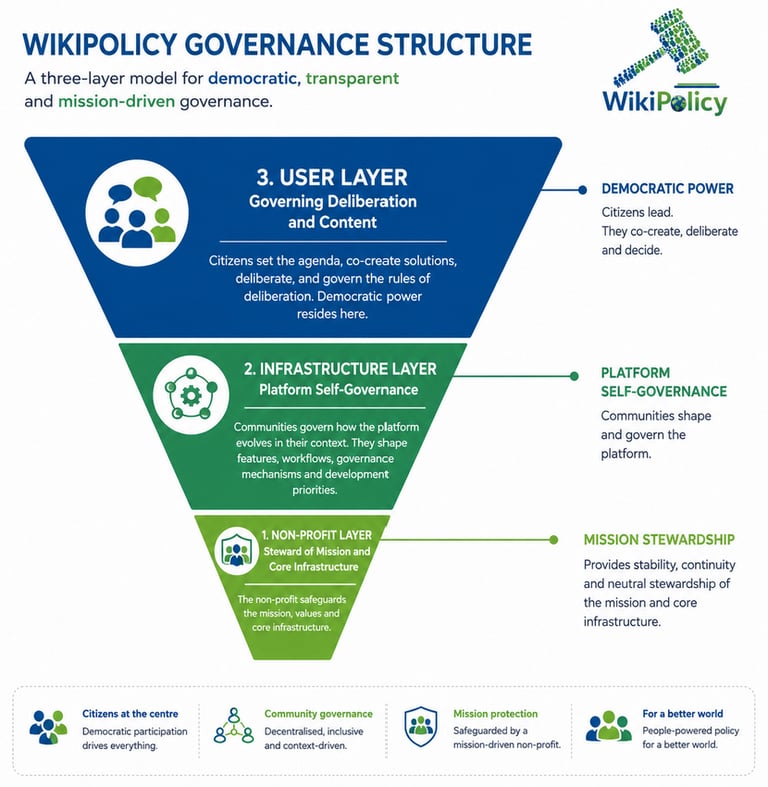
Wikipolicy breaks the institutional logic of traditional governance, where politic parties draft policy from their own institutional perspectives. Instead, it shifts policymaking power directly into the hands of citizens. This shift is self-reinforcing: the more citizens exercise their collective power, the more institutional power -with rigid and differentiated party programs - loosens. However, this only works if the approach remains radical and uncompromised. Wikipolicy can never be tied to a political party or legal entity, as doing so would reintroduce the institutional logic it seeks to replace.
To remain a democratic tool governed by and for citizens, Wikipolicy must evolve through collective participation across time, context, and levels of governance. The system itself can be reviewed, improved, and updated by its users, with no external authority defining the rules. Wikipolicy is designed as an adaptive democratic infrastructure - a digital commons - where democracy itself is treated as a shared resource, collectively owned and managed by citizens.
Radical self-governance
Radical neutrality
In this model, traditional government institutions implement citizen-defined policies. The legislative body continues to review and validate proposals, while the executive implements measures defined and approved by citizens.
The architecture of government does not change, but its direction of accountability does: legislative power shifts from political parties to a self-governed citizen structure. Political parties no longer compete primarily on ideological visions but on their ability to effectively implement citizen-defined policies. Governments’ role shifts from ideological authorship to democratic execution, from defining direction to delivering it.
Citizens set direction, government delivers









Democracy is only legitimate if it includes all those affected by its decisions. In today’s interconnected world, political choices - whether on climate, trade, or digital rights - often transcend borders, impacting people far beyond the jurisdiction where they originate. Wikipolicy addresses this reality by adopting a global democratic perspective, recognizing all citizens as part of a broader community shaped by collective decisions, while respecting local autonomy and cultural diversity. This fourth core principle ensures that democratic systems are designed with an awareness of global interdependence and shared impact, without erasing the unique contexts that give them meaning.
Designed for all citizens democracy's global perspective




Globalization demands coordination across borders, yet centralized authority risks distancing power from the people. Existing forums like the UN or EU often rely on compromise over consensus, leading to watered-down decisions that prioritise agreement over effectiveness. However, this apparent inefficiency serves an important purpose: it ensures that national priorities, cultures, and identities continue to shape global outcomes, rather than being overridden by distant, centralised authority. Wikipolicy resolves this tension by introducing multilayered democratic collaboration; enabling citizens to deliberate, co-create, and negotiate across borders while preserving national sovereignty. This approach ensures that global challenges (e.g., climate change, AI governance) are addressed collectively, without sacrificing local legitimacy or diversity.
Wikipolicy operates at subnational, national, regional, and global levels, mirroring the existing structure of decision-making authority. Each layer functions as a self-contained democratic ecosystem, shaped by its citizens through co-creation and self-governance:
National/Subnational: Independent platforms reflect local contexts, cultures, and traditions, allowing policies to emerge organically from the communities they serve.
Regional/Global: Additional layers enable cross-border collaboration on shared challenges (e.g., EU climate policy, global AI regulation). These platforms develop their own shared knowledge bases and include mandatory cross-country impact assessments, ensuring that distributional effects (e.g. costs, benefits) are visible and collectively examined before decisions are finalized.
By aligning participation with institutions that possess legislative authority, Wikipolicy ensures that citizen-generated proposals translate into meaningful policy outcomes. Regional and global platforms aggregate input across countries, generating disaggregated insights (e.g., by country) to highlight minority concerns and support negotiated trade-offs. This structure preserves local nuance while enabling coordination on transnational issues, reducing the risk of excessive centralization. The result is a system that is globally aware but locally grounded, turning collective consensus into political force while respecting the diversity of democratic communities.
The global governance paradox
A multilayered model of direct democratic governance








Wikipolicy represents more than just a new platform - it marks a fundamental shift in how democracy can work in the 21st century. At its heart, it’s about restoring power to the people and reimagining the role of institutions and technology in shaping our collective future.
With Wikipolicy, citizens reclaim agency. The agenda is no longer dictated by lobbyists, corporations, or unaccountable algorithms. Instead, it is shaped by those who are most affected by the decisions: the people themselves. This is democracy as it was always meant to be - by the people, for the people.
The platform also bridges the gaps between local concerns and global challenges. Through its multilayered and adaptive structure, it ensures that solutions developed at the community level can scale up to address broader, even worldwide issues. Democracy, in this model, is not confined by borders but empowered by collaboration.
Transparency, accountability, and neutrality are not just ideals; they are built into the system. Self-governance and robust identity verification ensure that every voice is heard, every decision is traceable, and every process is fair. This is how legitimacy is safeguarded in a digital age.
Finally, Wikipolicy maximizes impact by leveraging the best of what technology and institutions have to offer - without letting them take control. AI and legal entities are not the decision-makers; they are tools that enhance human effectiveness, ensuring that democracy remains a human-centred endeavour.
Humanity is entering an era in which unprecedented technological capabilities, are concentrated within a handful of powerful organisations. These actors are not only shaping markets and technologies but increasingly influencing the political decisions that govern society. If democracy is to remain relevant in the twenty-first century, citizens must build new tools to participate directly in shaping public policy and they must build it together. Wikipolicy should be seen as a first draft for such a new ambitious democratic infrastructure. An intent to start a joint process to re-build democracy, to restore the idea that citizens can and should govern themselves.
Why the core principles matter: a democratic revolution
www.wikipolicy.net